How founder-led B2B firms stay visible when search starts answering first
AI search visibility for B2B is no longer just an SEO concern. As ChatGPT, Google and AI Overviews answer more questions directly, a growing share of visibility is shaped before a buyer ever lands on your site.
This is no longer a speculative shift. AI summaries are expanding, zero-click behaviour is rising, and traditional rankings are becoming less reliable as a proxy for real attention.
For smaller consultancies, software firms and other high-trust offers, the risk is sharper. When your value depends on nuance, proof and positioning, being reduced too early can weaken trust before the conversation even begins.
200+
countries and territories where Google AI Overviews had expanded by May 2025.
56→69%
rise in zero-click search rate since the rollout of AI Overviews, according to Similarweb.
−58%
lower average CTR for the top-ranking page on queries with AI Overviews in the Ahrefs update.
20%
of EU enterprises with 10+ employees used AI in 2025, up from 13.5% in 2024.
95%
of hidden buyers say strong thought leadership makes them more receptive to outreach.
The shift in search behaviour is now measurable enough to describe without theatrics. Google has moved AI Overviews far beyond an early test phase. ChatGPT Search has become broadly available. Third-party datasets point to more zero-click behaviour and lower click-through rates when AI summaries appear. At the same time, AI adoption inside European businesses is rising, while B2B buyer research keeps showing that trust is often shaped before direct sales contact begins.
None of that proves that every search is now AI-led or that classic SEO suddenly stopped mattering. It shows something more useful: a growing share of digital visibility now takes shape before someone clicks through to your site.
The newer visibility question is not only “Do we rank?” It is also: what remains accurate, distinctive and trustworthy when our business gets condensed into a short answer?
That is where many B2B websites become more fragile than they look. A human reader can tolerate some decorative fog and still work out what you mean. A machine summary has no reason to rescue unclear positioning. It compresses what is there. If the original wording is vague, the summary usually becomes flatter still.
AI search visibility for B2B is now a content and trust problem
The timing matters because several shifts are converging at once rather than arriving one by one.
Discovery is becoming more answer-led. Clicks are becoming harder to win. AI use inside businesses is becoming normal fast enough to change expectations. And content is doing more pre-sales work than many teams still account for.
That combination does not make websites obsolete. It makes weak websites more expensive. AI search visibility for B2B depends less on publishing more and more on whether a company can be understood, cited and trusted when search systems summarise its pages.
Plainly put: if your site still depends on a visitor reading several sections, inferring your real value, and mentally cleaning up your positioning for you, the environment just got less forgiving.
Why this hits founder-led B2B firms harder than it first appears
Commodity offers can often survive on comparability. Specialist offers usually cannot.
In a consultancy, studio, technical service business or trust-heavy software firm, the value often sits in judgment, framing, process quality, trade-offs and knowing what not to promise. Those are exactly the things that do not survive vague language very well.
The hidden-buyer data matters here. If buyers increasingly form an opinion before speaking to sales, and if more of that early discovery is mediated through search systems, summaries and cited sources, then weak positioning is no longer only a branding problem. It becomes a commercial visibility problem.
That is why the Edelman / LinkedIn findings are so useful in this context. Hidden buyers are often lightly engaged with sales, but heavily involved in internal judgment. Strong thought leadership earns attention and confidence before a salesperson enters the room. In practical terms, that means your website, your articles and your reusable proof assets are doing more quiet commercial work than many teams assume.
Weak visibility often looks respectable but generic
The site sounds polished, but the real difference is hard to repeat. There is activity, but not much memorability. It reads fine and sells softly.
Stronger visibility sounds more lived and more specific
The claim is clearer, the proof is easier to find, and the business still sounds like itself after being summarised.
What current market data is already telling us about content and AI
The content market itself is already moving in the direction this article is describing.
Content Marketing Institute’s 2025 B2B research shows investment expectations rising in video, thought leadership and AI-related workflow support at the same time. That is not a small signal. It means the market is pushing simultaneously toward stronger source material, more credibility content, and more operational help around production.
But the same research also explains why simply scaling output is not a serious answer. Many teams still lack a scalable model for content creation, and trust in generative AI outputs remains limited. That gap matters. It suggests that the real need is not more publishing pressure. It is better raw material, better structure and better editorial judgment around the parts AI can accelerate.
The useful lesson is not anti-AI. It is anti-laziness. AI helps most when it reduces repetitive work around good material. It helps much less when it is asked to replace positioning, proof, or editorial thinking.
What Google is actually saying and what that rules out
Google’s own documentation is useful here precisely because it is not dramatic. There are no extra magic requirements for appearing in AI Overviews or AI Mode beyond standard search fundamentals.
That rules out a lot of wishful thinking.
Google keeps pointing site owners back to the same basics: allow crawling, make important pages findable through internal links, keep key content available in text form, use images or video where they genuinely support the page, and make sure structured data reflects visible content.
So the environment changed, but the cure is not gimmickry. It is still clarity, structure, accessibility and evidence.
Interpretability is now part of content quality
Content quality used to be discussed mostly in editorial terms: is it useful, accurate, relevant, well written?
Those questions still matter. But another one now sits right underneath them:
Can this page be interpreted well when it is summarised?
If your homepage needs a full sales conversation to make sense, that is already expensive. If your service page becomes almost meaningless once reduced to a short answer, that is worse. And if your proof is too thin to survive compression, then being “visible” may still not help much.
A machine summary does not invent depth you forgot to publish.
Why “more content” is often the wrong reaction
The predictable response to these shifts is volume. More posts. More pages. More AI-assisted publishing. More motion so nobody has to admit the existing materials are still too vague.
Usually that is the wrong move.
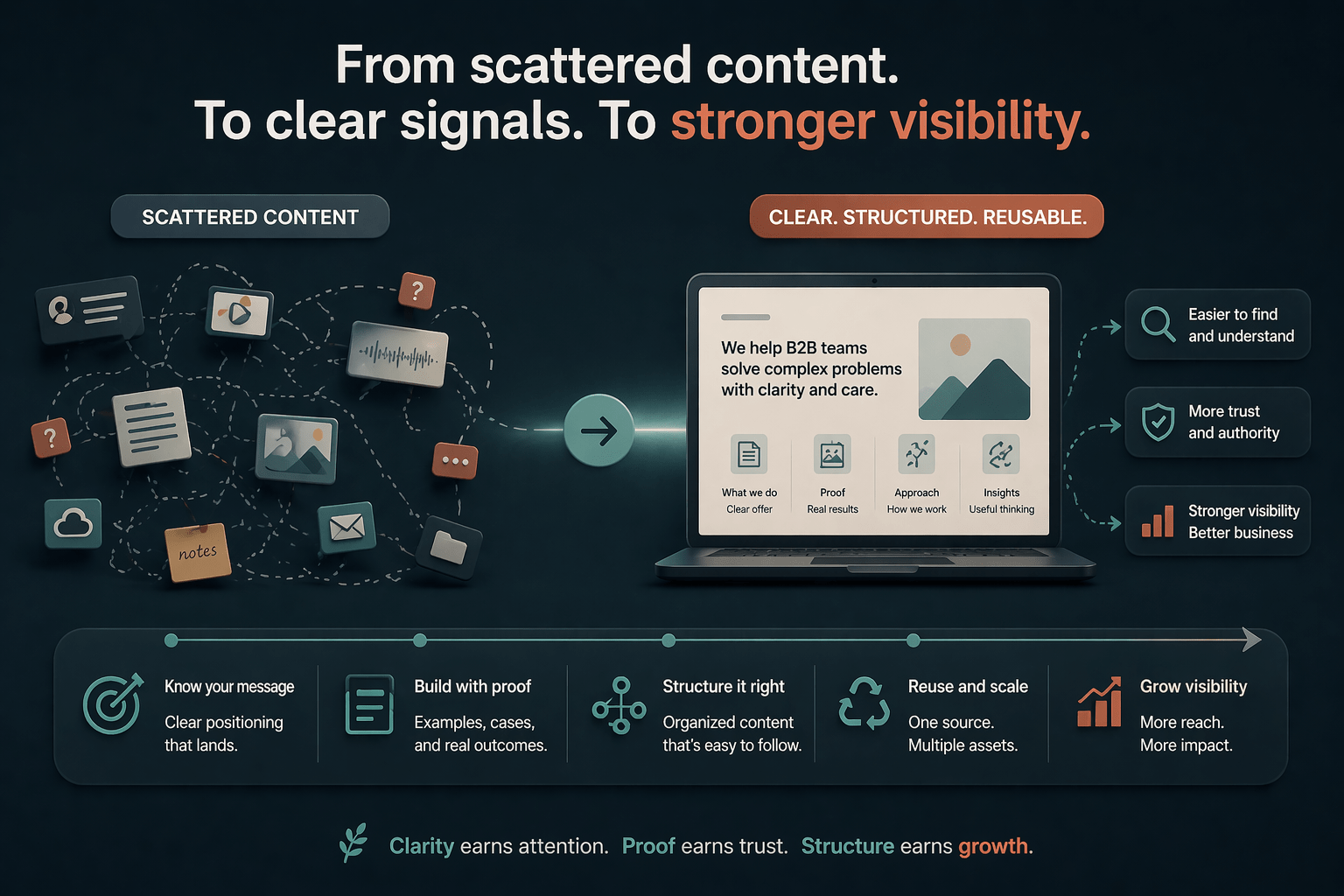
Many founder-led companies do not have a content quantity problem. They have a clarity problem, a proof problem, a reuse problem, or a source-material problem. They already have enough expertise somewhere in calls, recordings, notes, project documents, decks and founder explanations. What they often lack is a better path from expertise to useful visibility.
For founder-led firms, AI search visibility for B2B improves when positioning, proof and source material are clearer before any AI-assisted discovery layer touches them.
This is where the logic behind AI-assisted content workflows is strategically sound: not content at scale for its own sake, but a more reliable path from strong source material to usable, reviewable assets.
Where AI helps — and where it starts sanding the edges off
AI is useful when it clears repetitive work around material that is already worth saying.
That includes transcription, subtitle drafts, clip candidate discovery, first-pass organisation, rough summaries, tagging, archive support and some workflow automation. It does not mean the system should quietly decide what your business actually promises or what your point of view really is.
Once AI starts flattening nuance into safer, broader, smoother language, you can usually feel the loss even when you cannot name it immediately. The page sounds acceptable. It just no longer sounds like it came from someone who has done the work.
Why video still matters here for a more practical reason
This does not mean video is directly rewarded by AI search. The stronger point is simpler.
A good recording often contains the clearest raw material for pages, FAQs, articles, proof sections and thought-leadership pieces that can later be cited, summarised and trusted. Strong video is often useful because it produces better source material, not because it magically guarantees visibility on its own.
That matters because B2B investment signals are already moving toward video and thought leadership together. The smarter move is not to keep those in separate silos. It is to treat video as one of the best inputs into stronger written assets and more credible proof.
That is also the deeper connection between cinematic video editing and structured content workflows. One gives the material more weight. The other helps it keep working after the first publish.
What to fix first on a real website without overengineering it
If a site already exists and is not fundamentally broken, I would not begin with a giant AI-search project. I would begin with smaller, stricter choices.
1. Tighten the homepage until it stops wobbling
One clear statement about who you help, what friction you reduce and why your approach is different beats a wider but blurrier explanation almost every time.
2. Build more proof pages and fewer polite abstractions
If your site contains many claims but not enough examples, cases, process detail, before-and-after logic or clear boundaries, both buyers and machines have less to hold onto.
3. Treat source material as an operating asset
Calls, webinars, workshop recordings, founder notes and internal explainers should not live as isolated fragments if they are central to how the business thinks. They should feed the website, the blog, sales support and future reuse.
4. Reduce tool chaos where it weakens communication
Scattered content systems usually create scattered messaging. When recordings, transcripts, approvals, notes and published assets live across too many tools, the result is rarely just operational friction. Over time, it shows up in the communication itself: duplicated claims, inconsistent wording, slower approvals, weaker proof and pages that feel assembled rather than thought through.
That is why content quality and operational clarity are often more connected than teams assume. In smaller firms especially, a messy operating layer does not stay in the background. It eventually reaches the website.
5. Add structure before adding more publishing pressure
Better internal links, clearer page roles, stronger text hierarchy and cleaner archives usually pay back faster than asking the team for more output next week.
One useful editorial test: if a search system had to explain your company in three sentences using only what is currently on your site, would you trust the result?
Where operations and trust still enter the picture
Content strategy is often discussed as if it floated above the systems underneath it. For smaller businesses, that separation is usually artificial.
If approvals, files, transcripts, client material and handovers move through too many disconnected tools, the quality of the published result often suffers. Not always spectacularly. Sometimes just enough to make the whole thing feel thinner and more fragile than it should.
That is the sensible point where something like a privacy-first stack setup can become strategically relevant. Not because every firm should turn itself into an infrastructure project, but because calmer systems often support calmer communication.
A practical standard for 2026
If the terminology around GEO, AEO and AI search starts sounding a little too theatrical, the calmer version is this:
- one homepage with a clear market-facing claim
- a small number of genuinely useful service pages
- proof-rich articles or case-style pages
- enough visible text for your offer to be interpreted correctly
- better internal links between related pages
- stronger source material underneath the polished output
- AI used as support, not as editorial autopilot
That is not flashy advice. It is just more likely to survive contact with the way search now works.
Final thought before the next round of AI hype
The old visibility question was simple: how do we rank?
The newer one is less flattering: what still sounds accurate, distinctive and credible once our business is compressed?
The firms that will do better in this environment are not automatically the loudest or the fastest publishers. More often, they are the ones with clearer positioning, stronger proof, better source material and less self-inflicted vagueness.
Or put less politely: the era of being sort of clear on your website was already expensive. It is getting more expensive.
If this sounds familiar for your own site
If your business already has useful expertise, real delivery experience and material worth publishing, but the website still feels thinner than the work behind it, the problem is probably not a lack of topics.
More often, it is a mix of positioning drift, weak proof, scattered source material and pages that still sound too broad once the design is stripped away.
That is the layer I work on through AI-assisted content workflows, selective documentary-style editing and, where it genuinely makes sense, privacy-first operational setups.
If you want the broader context first, start with the homepage overview or About Nomadic Filmworks.
Related reading if you want to go deeper
A few useful next reads — both from my site and from the source material behind this article: